
The Commonwealth Association of Architects (CAA) has today published initial findings from its landmark 2025 Survey of Architecture Students, Graduates and Early-Career Professionals in the Commonwealth. The project and publication, authored by CAA Youth Representative, Hugo Chan, is the first research census of its kind which aims to capture the voices of architecture students and graduates aged 18 – 35. The survey, conducted between February to July 2025, marks an important milestone for the CAA as it celebrates its 60th Anniversary. It is the first systematic, evidence-based effort to understand the lived experiences, aspirations, challenges and concerns of young architectural professionals across the Commonwealth. Drawing on responses from over 500 participants spanning twenty-six countries and all five Commonwealth Regions, the report paints a vivid – and at times, sobering – portrait of the architecture profession’s next generation.
About the Interim Findings Report
The report draws from hundreds of qualitative data submissions and over 1,000 written response submissions, spanning sixty-five survey questions covering multiple areas of inquiry:
- National Architecture Institute and CAA Organisational Visibility
- Perceptions of the Architectural Profession
- Experiences of Architectural Education
- Continuing Professional Development (CPD) Experiences
- Perceptions of Professional and Education Support in Architecture
- Awareness of the United Nations Sustainable Development Goals (SDGs)
A Profession in Tension: Idealism Meets Structural Barriers
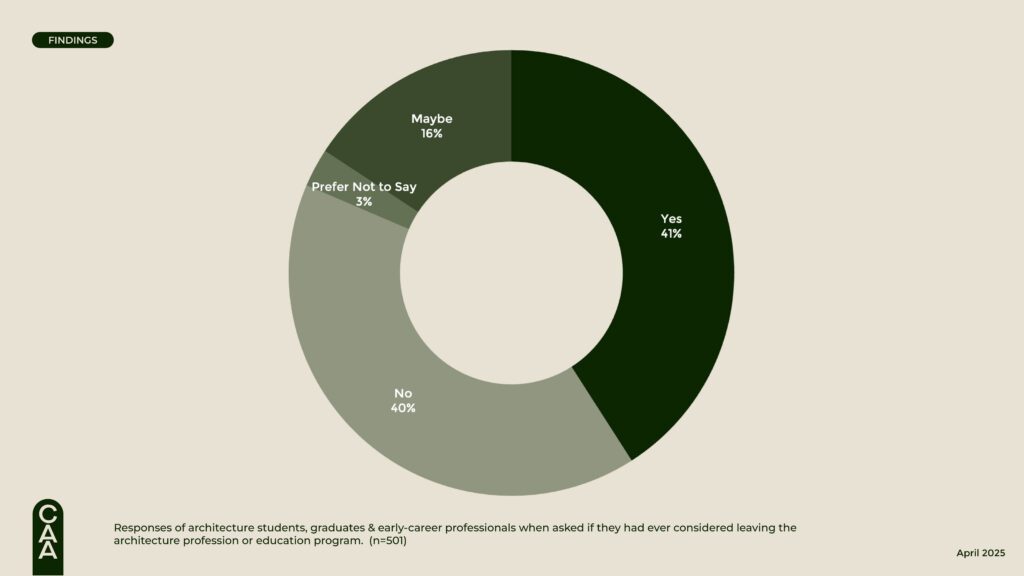
Despite strong levels of personal commitment to the profession, with 74% of respondents affirming that architecture was the right profession choice, a troubling counterpoint also emerged – 57% of respondents had considered leaving architecture altogether. Qualitative responses noted that students and graduates alike were being driven to disillusionment with the profession owing to inadequate pay (75%), excessive workload and burnout (55%) and limited job opportunities (45%) being the leading reasons for reconsidering a career in architecture.
The report highlights a core tension – that the extraordinary demands of investment of time, energy and resources required of students, appears to be failing to deliver commensurate financial reward, professional recognition or sustainable working conditions. Barriers to the profession, including perceptions of inequity and bias (25%), confusing registration processes (30%) and a persistent gap between education and real-world practice (40%) are cited as contributors to this issue.
Mental Wellbeing: A Crisis Spanning Across Education and Practice
An underlying mental health crisis has emerged as a central and urgent issue across both education and practice in architecture. Over half of respondents (52%) indicated they did not feel adequately supported in their mental wellbeing and 54% perceived architecture as more stressful than other professions. Nearly two-thirds of students (65%) reported that their institution had not provided adequate representation or support for their needs. In analysing the 499 written responses around the issue, students, graduates and architects alike described professional culture as one which normalises extreme workloads, takes pride in sleep deprivation and weaponising relentless pressure as a pedagogical tool – a pattern which was found across all five Commonwealth regions and which the report flags as requiring immediate and urgent attention.

Sustainability and the United Nations Sustainable Development Goalss (SDGs): Aspiration without Meaningful Integration
The survey revealed near-universal agreement that climate change education (89%) and integration of the SDGs into architectural curriculum (83%) was important and valuable. Unfortunately, fewer than half of respondents (43%) indicated that the SDGs were part of their education and only 42% of respondents indicated that they had regular engagement with the SDGs through CPD. The gap between what architects feel to be important versus opportunities for knowledge acquisition represents an important opportunity for curriculum reform and targeted professional development.

Lessons for Practitioners, Educators and Policymakers
Overall, the interim report’s findings carries clear implications across the profession:
- For Practitioners: Persistent issues of pay, work hours and toxic workplace culture is driving a talented generation of creatives out of the professions. Firms and institutions should proactively reflect on their working and education conditions alongside improved mentorship opportunities to nurture emerging talent.
- For Educators: The gap between architectural education and professional practice across all regions of the Commonwealth is indicative of a broader systemic issue. The potential for reforming studio cultures which fosters and nurtures creativity, rather than one which relies on pressure and torment. Curriculum reforms should also seek to better integrate technical skills, business literacy and sustainable practice founded upon the SDG principles, to genuinely prepare architectural graduates for the realities of entering the workforce.
- For Professional Bodies & Institutions: Helping to foster understanding around registration will be key to ensuring the next generation of architects are recognised as qualified professionals. With 41% of respondents indicating that they are not members of their national architectural institute across the Commonwealth, opportunities to improve, such as through student membership discounts and providing greater certainty around membership benefits ought to be addressed to encourage greater and more active participation within the architectural fraternity.
- For Policymakers: Artificial intelligence, climate change, rapid urbanisation and deregulation of practice were the top concerns identified by respondents when considering the future of architecture by 2050. Frameworks must evolve to address these intersecting challenges and ensure the profession retains the public trust it deserves and relevance within the wider construction industry.
A Prologue, Not an Epilogue
Reflecting on the survey findings, Hugo Chan, CAA Youth Representative said:
“This survey was born from a simple but powerful notion: Before we can shape the future of architecture across the Commonwealth, we must first listen to those who are living it. The findings are, in many ways, a call to action. Our profession has long attracted idealists – individuals who are driven by creativity, social purpose, and a desire to affect meaningful change in the built environment. Unfortunately, this survey is showing that many young designers are now being pushed out by a system where survival has become harder than design. This report represents a step towards diagnosing this crisis in architecture and hopefully, becomes the foundation to affect change.”
This Preliminary Findings Report is the first publication arising from the 2025 survey. Over the coming months, progressive rollout of the findings on social media and the commencement of the 60 Years, 60 Voices initiative will represent the first steps toward addressing some of the issues highlighted by the report. The Full Report on the Survey Findings is due to be published in September 2026 as part of the in:Situ Conference and CAA General Assembly hosted by Te Kāhui Whaihanga New Zealand Institute of Architects . The full report will include comprehensive analysis of the findings, cross sector comparisons to other professions and recommendations for short-, medium- and long-term actions to address intergenerational knowledge gaps and help to improve the profession of architecture across the Commonwealth.
Interim Findings Report (Version II, April 2026)
The Interim Findings Report has been made freely accessible online and you can access it via the flipbook below or the website link here.